Back in 1982, I wrote one of my first extended genealogies. William Tryon was a “royal governor” of North Carolina. I knew that meant he was appointed by the King of England, but I thought maybe he might have had actual royal ancestors I could trace.
This was many years before the internet, so I did my research the old-fashioned way in my local public library in New Bern, NC. I also had some pages I had photocopied in the past from a journal I had found in another library in Roxboro, NC.
I typed this booklet on a little portable typewriter I had bought for college in 1971. I photographed the pages, converted the images to black and white, and cleaned them up. Because of the variable darkness of the type and the fact that I used a camera instead of a scanner, some of the text is hard to read and blurry. I apologize. I will replace this file later when I get my scanner working again.
This is a very short booklet, based on the information that I had available at the time. It would be many times larger, if I wrote it today. I may rewrite it in the future.
I have always had trouble falling asleep quickly at night. My brain continues to work full speed, rehashing everything, from the current day’s events all the way back to things that happened in my childhood. I searched for a solution for many years. I even got a prescription sleep medicine and took it just one time. It didn’t help me sleep at all, and I was a zombie the whole next day. So I flushed them. Melatonin tablets help sometimes, but even then, I don’t always go to sleep after the melatonin has made me sleepy.
A little over four years ago, I heard about something called a “brain dump.” I don’t remember the details of how I found out about it. It did sound promising. I found a very good video by Carie Harling titled: “The Whys and Hows of a Brain Dump.”
Carie’s basic premise is that your brain is for thinking, not for storage. She says to keep a cheap small notebook handy, and whenever you think of something, write it down immediately. Don’t stop to do anything about it, such as adding it to a to-do list or putting it on your calendar. Just write it down, so that it’s no longer necessary to think about it, because it’s safely on paper.
Always note the date when you start writing. Later on, you can come back to the brain dump book and look over the items. At that time, you can take care of items, whether it’s something you can do immediately, or you add it to your schedule, or you delegate it. As you take care of an item, cross it off in the brain dump book, as it’s no longer needed there. As you finish all the items on a page, cross off the whole page.
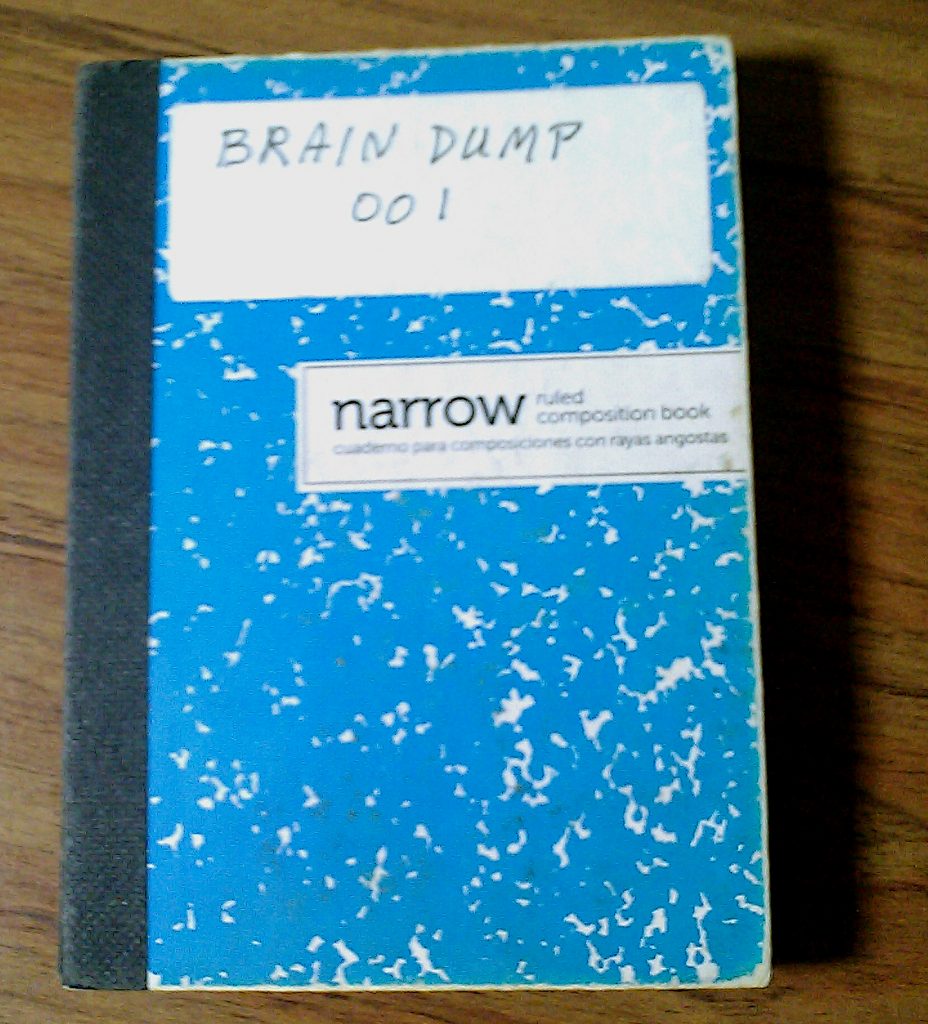
Here is a photo of my brain dump book. I bought a package of cheap 4.5″ by 3.25″ notebooks at the office supply store. I put an address label on the front and labeled it “BRAIN DUMP 001,” as it’s the first one, and I didn’t know how many I would eventually use.
I bought the notebooks on June 6, 2016, and started writing on the first page of the first book that night just before bedtime. I filled six pages with 86 items. I had a lot on my mind!
I have crossed off almost all of those items and all but one page. There are several items that I want to do someday, but I can’t schedule them. Some people flag those items with Post-it tabs.
About two-thirds of my first book is full. I have found it useful, and I hope you will too.
Here are a couple of other good videos on brain dumps:
Please check out the YouTube channels of all three women, as they are very interesting. They are really into scheduling, journaling, bullet journals, fancy notebooks, fancy papers, and fancy pens.
The impetus for my decision to research and write more came from a YouTube video by Carie Harling. She has a great series on organization, but she has also done some shorter series.
I recently watched the first in a series she did called “Find A Why Not.” The basic premise is that, when you tell people you are planning on going in a new direction, they always ask you “Why?” Carie says to turn that around and ask “Why not?” She gives hints on how to find your “why not” that might be one of your purposes in life.
I have had a lot of jobs in my life, and none of them were completely satisfying and only really led to my retiring as soon as I possibly could at the age of 50 (actually four days shy of my 51st birthday). So I have been floundering without a clear purpose for 15 years now.
I watched Carie’s video and decided to find my “why not.” I looked at what I have spent the most time doing that I also enjoyed the most. Carpentry was one phase I went through. I even bought a Shopsmith years ago. It’s sitting in the garage unused. Gardening was a bigger phase. I built a 12 x 24 greenhouse in the backyard, set up a large number of raised beds using the square foot gardening method, and grew lots of flowers and vegetables. My health spoiled that, and now the garden is gone and the greenhouse is going to pot.
Then I realized that the one thing I have done consistently over many decades is research and write about things that interest me. You can read about that in my “About Me” page linked in the top menu. So I thought, “Why not research and write full time?” Being retired on fixed income means I don’t have the pressure of trying to make money from writing. I will post things that I have written in the past, so they might find a bigger audience. I will write on a lot of subjects: genealogy, family stories, my life, music, and whatever else suits me. I hope you will find some of it interesting.
This is an essay I originally wrote on July 21, 1970. It gives the origin of my interest in genealogy and the beginnings of what I knew at the time about my family. The essay is incomplete, contains some errors, and is reproduced here exactly as I wrote it. I used a revised version of the first paragraph as the introduction to my book “The Slaughter Family: The Ancestors and Descendants of Jacob Schlotterer of Bodelshausen, Germany,” which I first published in 1989.
The Origin of the Slaughter Family in America
My first interest in this subject came as a result of a health assignment in the eighth grade. The teacher, Mrs. Williams, told the class that she wanted them to make family trees. I wanted mine to be the largest. So, when I got home that afternoon, I asked my mother questions. At first I had only the names of my parents, grandparents, and great-grandparents. Then I added on my aunts, uncles, and cousins. Of course, I had no idea that I had left out most of them. The next day, the teacher looked at my family tree. She noticed one of my great aunts and said that my great uncle was her cousin. That was when I discovered how many people could be related to me.
Since that time, I have tried to find out the names of my ancestors as far back in time as possible. I have found out that one of my ancestors came to America in the 1700’s from Germany. He brought his family and settled in North Carolina north of Raleigh. His earliest descendant that I know the name of is Jacob Glover Slaughter, my great-great-grandfather. He had two children, my great-great-uncle, Rufus Slaughter, and my great-grandfather, Nuptial Blair Slaughter. Nuptial married a Martha Ann, by which he had nine children. Their names are Jacob, Rufus, Moses Thornton, Rachel, August Columbus, Lizzie, Charlie Bratcher, Theophilus Elbert, and Samuel. Jacob Slaughter was known to his nephews as Uncle Jack. His sons are Robert and Ervin. Moses Thornton Slaughter was known as Uncle Chummy. He married twice. Della was his first wife. She had five children, Nelly, Elmer, Henry, Paul, and Christine. Lila, his second wife, had Hubert. August Columbus Slaughter, Uncle Gus, had fifteen children. Their names are, in order of birth, Johnson Roy, Lillian Vide, Nobie Blair, Mallie Mae, Thomas Worth, Osborn, Onnie Elizabeth, India Annar, Otha William, Obie Gentry, Marey Dorcas, Betty Louise, Laura Thompson, Marthy Ann, and William S. Uncle Gus’s wife’s name is Lula Hicks.